The Algorithm & The Awakening, Part 1
A Two-Part Series on Artificial Intelligence, Our Communities, and Our Future
Listen with Music:
Listen without Music:
PART ONE: Wake Up—The Machine Is Already Here
SECTIONS: Self-Assessment | The Digital Divide | The Rise of the Oligarch | Industry 3.0 | What Is AI? | Who Really Invented It? | LLMs & the Writer’s Role | What’s Next | How AI Affects Urban Communities
“The most dangerous place to be in a revolution is on the sidelines.”
First, A Mirror: Self-Assessment
Before we talk about algorithms, before we discuss data models or trillion-dollar tech empires, we need to start with an honest question—Where are you right now?
Not geographically. Technologically. Culturally. Economically.
Do you know what Artificial Intelligence actually is, beyond the headlines? Have you used it today—knowingly or not? Do you understand how it is shaping the opportunities your children will or will not have access to? Are you building in this new economy, or are you being built upon?
This is not a guilt trip. It is a diagnostic. And like any good doctor, we cannot prescribe a remedy until we have an honest assessment of the condition.
The people who will thrive in the next twenty years are not necessarily the smartest or the hardest working. They are the most informed and the most intentional. The revolution happening right now in artificial intelligence is not waiting for anyone to catch up. The question is not whether AI will change your world. It already has. The question is: will you be a participant, or a product?
Take a moment. Assess yourself. What do you know about this space? What have you done with what you know? What will you do differently after reading this?
That honest reckoning—that willingness to look in the mirror—is where this journey begins.
The Digital Divide: Old Problem, Lethal New Form
The digital divide is not a new conversation. For decades, researchers, activists, and educators have documented the gap between communities with robust access to technology and those without—the gap between broadband and dial-up, between a laptop at home and a shared library computer.
But we are no longer talking about the old divide. We have entered a new and far more dangerous phase.
As of 2025, an estimated 2.6 billion people—roughly 32% of the global population—remain completely offline. And while 93% of people in high-income countries use the internet, only 27% in low-income countries do the same. In Afrikan nations specifically, approximately 63% of the population still lacks internet access. These are not abstract statistics. These are our grandmothers. Our cousins. Our communities.
But here is the new threat: even among those who are online, a second-tier divide has emerged—the AI Divide. This is the gap between those who can access, use, shape, and benefit from artificial intelligence, and those who cannot. The National Urban League’s annual State of Black America report has warned plainly that we are on the brink of “a new economic segregation—one where algorithms and automation create walls of opportunity.”
This is not hyperbole. This is policy. This is code. This is the architecture of tomorrow being built right now—and in most of our communities, we are not in the room where it is happening.
The AI divide is not just about internet access. It is about AI literacy. It is about who has the data. It is about whose cultural context, whose language, whose history is embedded in the intelligence being built. AI systems are overwhelmingly trained on data drawn from Western, English-speaking, and affluent societies. This means that the needs, languages, values, and cultural contexts of Black, Indigenous, and Global Majority communities are routinely missing—or worse, distorted—in the systems that will govern hiring, lending, policing, healthcare, and education.
A 2019 study by the National Institute of Standards and Technology tested 189 facial recognition technologies and found strong bias against people with darker skin tones, disproportionately impacting people of Afrikan descent. This is not a bug. In a system built on skewed data, it is a predictable outcome.
The divide is widening. And the window to act is narrowing.
The Evolution of the Oligarch: From Robber Barons to Algorithm Lords
To understand where we are, we must understand who is driving this machine—and why their interests and ours are not the same.
In my book, ‘From Railroads to Robots: The Evolution of Power and Wealth: Eugenics Role in Oligarch’s & Monopolies’, I noted how every major industrial revolution in American history has produced a ruling class of wealth that shaped the world in its image. In the late 1800s, men like John D. Rockefeller (oil), Andrew Carnegie (steel), and J.P. Morgan (banking) consolidated enormous power through monopolistic control of the physical infrastructure of their era. They were called Robber Barons, and their wealth was staggering—but it was tied to physical assets.
The 20th century saw a new class emerge: media moguls, defense contractors, and financial titans who controlled the flow of information and capital. Their power was still leveraged by things—airwaves, newspapers, factories.
But the 21st-century oligarch controls something far more powerful: data and the intelligence built on it.
Today, a handful of men—Elon Musk, Jeff Bezos, Mark Zuckerberg, Bill Gates, Sam Altman, Jensen Huang—control the most consequential technologies in human history: AI systems, cloud infrastructure, social media platforms, and increasingly, the regulatory environment that governs them. Their combined wealth exceeds the GDP of most nations. Their companies hold more behavioral data on the human population than any government has ever held.
This is not capitalism as we knew it. This is something new. This is algorithmic feudalism—a world where the lords own the invisible infrastructure of thought itself: the search results you see, the content you consume, the job applications that get filtered, the loan applications that get denied.
The question is not whether to be angry about this. The question is what we are going to do about it. Because history shows that those who understand the infrastructure of their era—and learn to build within it—are the ones who create generational wealth, not just generational critique.
Industry 3.0: The Revolution We Slept Through
To understand where we are going, we must understand where we have been.
Historians of technology typically speak of industrial revolutions in waves:
Industry 1.0 (late 1700s–1800s) was the age of steam, mechanization, and the factory system. It transformed agrarian societies into industrial ones. For POADUS (People of Afrikan Descent in the United States), this revolution was built on our backs—enslaved labor was the engine of the cotton economy that funded much of Western industrialization.
Industry 2.0 (late 1800s–early 1900s) was the age of electricity, mass production, and the assembly line. Henry Ford’s factories. Carnegie’s steel mills. The rise of the American middle class—largely for white Americans, while POADUS communities were systematically excluded through Jim Crow, redlining, and racial violence.
Industry 3.0 (mid-1900s–early 2000s) was the digital revolution: computers, the internet, automation. This era created Silicon Valley, the dot-com boom, and the modern tech economy. Once again, POADUS communities were largely left on the margins—locked out of venture capital, underrepresented in tech companies, and targeted as consumers rather than empowered as creators.
We are now in the early stages of Industry 4.0 (also called the Fourth Industrial Revolution)—the age of AI, quantum computing, biotechnology, and the merging of the physical and digital worlds. This revolution will be more disruptive than all the previous ones combined.
The time to engage is now. Not after we understand it perfectly. Not after someone else maps it out. Now! Because those who miss this wave will not simply be left behind economically. They will be rendered structurally invisible in the systems that govern every dimension of life.
We Are Responsible for AI
Here is something the mainstream technology conversation rarely admits: AI is not neutral. It reflects the values, priorities, and blind spots of the people who build it.
When an AI hiring tool discriminates against POADUS applicants—as Amazon’s own internal recruiting AI was found to do before it was quietly shelved—that is a human choice embedded in code. When a predictive policing algorithm over-surveils POADUS neighborhoods, that is a human choice encoded in training data. When AI-generated imagery defaults to Eurocentric beauty standards, that is a human choice baked into the model.
We—all of us, but especially those of us whose communities are most impacted—bear a responsibility to engage with, critique, shape, and build AI. Not just to use the consumer-facing products, but to understand what is underneath them.
This is not just a tech issue. It is a civil rights issue. It is a cultural sovereignty issue. It is a survival issue.
What Is AI, Really?
Strip away the science fiction. Strip away the hype. At its most fundamental level, Artificial Intelligence is the science and engineering of creating machines that can perform tasks which normally require human intelligence—things like understanding language, recognizing patterns, making decisions, and generating content.
AI is not magic. It is mathematics at scale. It is pattern recognition powered by vast amounts of data and extraordinary computing power.
The most prominent AI systems you encounter today—ChatGPT, Google Gemini, Apple Intelligence, Claude—are examples of what technologists call Generative AI: systems that can create new content (text, images, video, code) based on patterns learned from enormous datasets.
Beneath generative AI is a technology called the neural network—a computing architecture loosely inspired by the human brain, designed to learn patterns by processing examples. When you train a neural network on millions of medical images, it learns to detect tumors. When you train it on billions of words of text, it learns language.
There are multiple categories of AI:
Narrow AI—designed for specific tasks (facial recognition, recommendation algorithms, GPS navigation). This is what most of us interact with daily.
General AI (AGI)—a hypothetical system with broad, human-like intelligence across domains. This does not yet exist.
Superintelligence—a speculative future category in which AI surpasses human intelligence entirely.
We are firmly in the era of Narrow AI, but the pace of advancement is accelerating in ways that are difficult to overstate.
Who Invented AI? The Deeper History
The conventional Western history of AI begins in 1950, when British mathematician Alan Turing posed the question: “Can machines think?” His landmark paper, Computing Machinery and Intelligence, introduced what became known as the Turing Test—a framework for evaluating whether a machine could converse indistinguishably from a human.
In 1956, researchers at Dartmouth College—John McCarthy, Marvin Minsky, and others—formally coined the term “artificial intelligence” at a summer conference, launching AI as a recognized academic discipline.
These are important milestones. But they are not the whole story.
The deeper history of intelligence—of systems of knowing, categorizing, and transmitting wisdom—stretches back thousands of years before Turing, and it does not begin in England or New England.
The ancient Egyptians encoded complex mathematical and astronomical knowledge systems thousands of years before the Western academy.
The Dogon people of West Africa preserved cosmological knowledge of the Sirius star system that baffled modern scientists when it was documented in the 20th century.
The concept of the Ubuntu philosophy—”I am because we are”—represents a form of collective, relational intelligence that is architecturally different from, and in many ways more sophisticated than, the individualistic, hierarchical logic embedded in most Western AI systems.
I will return to this ancestral thread in Part Two, because it holds the key to building AI that actually serves humanity rather than exploiting it.
LLMs and the Need for Writers, Thinkers, and Storytellers
One of the most profound developments in recent AI history is the emergence of Large Language Models—or LLMs.
An LLM is an AI system trained on billions of words of text: books, websites, articles, social media posts, academic papers, and more. By processing this vast collection of language, the model learns to predict, generate, and manipulate human text with striking fluency.
ChatGPT, Google Gemini, Microsoft Copilot, and Claude are all examples of LLM-powered systems. They power everything from customer service chatbots to legal document drafting to creative writing assistance.
Here is what the mainstream conversation almost never tells you: every LLM runs on human language—and without writers, thinkers, and storytellers, there is no LLM.
The intelligence of these models is entirely derivative. It is extracted from human creative and intellectual output. Every novel, every essay, every poem, every speech, every article that was ever digitized and fed into these systems is inside the model. The writers, historians, philosophers, journalists, and griots of human civilization are the model.
This creates both an ethical crisis and a strategic opportunity.
The ethical crisis: most content creators—especially POADUS writers, Indigenous knowledge keepers, and Global Majority scholars—have received zero compensation for the use of their work in training these systems. Their intellectual labor has been strip-mined by trillion-dollar companies without consent or credit.
The strategic opportunity: writers are not obsolete. Writers who understand AI—who can prompt it, direct it, critique it, and build with it—are among the most valuable professionals of this era. The age of the AI-powered writer, the AI-fluent educator, and the AI-literate community builder is just beginning. And it belongs to those bold enough to step into it.
What Is Next in AI
The pace of AI development is not slowing. If anything, it is accelerating.
Here is what is emerging and what you need to watch:
Multimodal AI—AI systems that can seamlessly process and generate text, images, audio, and video together. We are already seeing early versions of this with tools like GPT-4o and Google Gemini. Within the next few years, this will be everywhere.
Agentic AI—AI that does not just respond to queries but takes actions on your behalf. Booking appointments. Drafting emails. Managing workflows. Running business processes. The shift from AI as a tool to AI as an agent will fundamentally reshape employment and organizational structures. Your job is no longer safe!
AI in Healthcare—Diagnostic AI that outperforms human doctors in reading medical imaging. Drug discovery models that collapse the timeline for pharmaceutical development from decades to months.
AI and Education—Personalized AI tutors that adapt to individual learning styles in real time. This could be revolutionary for underserved communities—or it could deepen inequity if access is not equitable.
AI Legislation and Governance—Governments globally are racing to regulate AI. The European Union’s AI Act is the world’s most comprehensive framework. In the U.S., the policy landscape remains fragmented and industry-influenced. Who shapes these regulations matters enormously for communities that have historically been harmed by unregulated technology.
The AGI Question—Leading AI researchers are genuinely debating whether Artificial General Intelligence—an AI with broad human-level or superhuman capability—could arrive within this decade. Some, like OpenAI CEO Sam Altman, believe it is imminent. Others are more skeptical. Regardless, the pursuit of AGI is reshaping investment, research, and geopolitical competition in ways we are only beginning to understand.
How AI Affects Urban Areas and Black Communities
Let me be direct. The communities with the most to lose—and the most transformative potential to gain—from the AI revolution are urban, working-class, and communities of color.
On the loss side, automation is disproportionately threatening jobs held by us. Transportation, warehousing, customer service, food service, and administrative roles—sectors where POADUS workers are overrepresented—are among the most vulnerable to AI automation. Without intentional intervention, this wave could be economically catastrophic.
The threat of automation is not occurring in isolation; it is building upon centuries of systemic inequity. POADUS’ have long been denied access to generational wealth-building opportunities, from redlining and housing discrimination to wage gaps and job segregation. AI, deployed without equity as a core design principle, threatens to encode and amplify these historical exclusions.
On the gain side, AI has the potential—if deployed with intention and equity—to be transformative for urban communities. AI-powered tools for disease tracking, personalized education, small business development, legal aid, and housing advocacy could be game-changing resources for communities historically denied access to these services.
But access is not enough. The most marginalized communities—women, people of color, disabled individuals, and others—bear the brunt of the AI divide. The path forward requires AI literacy, AI advocacy, and AI authorship—communities not just using these tools, but shaping them.
The time for awareness is now. The time for action is also now.
Your Next Step Begins Here
This is not the end of the conversation. This is the beginning.
In Part Two of this series, I will go deeper—into the historical Afrikan connection to intelligence systems, the concept of AI Frequency, AfrikanFuturism, the philosophy of Kgotla, and the roadmap for what our communities must build before 2030 and by 2048.
But between now and then, there is work to do. Share this article. Start the conversation in your family, your network: school, organization, and church. Because the first step to navigating any revolution is knowing you are in one.
To go deeper with this work—explore the books, courses, and community initiatives referenced in Part Two. The movement is being built, and there is a seat at the table with your name on it.
» Continue to Part Two: “The Original Intelligence—Our Resolve, Our Roots, and Our Road to 2048”
📍BOOK ME—LITERALLY—for talks and podcast appearances! ✊🏿
Review my Speaker Kit: https://mbwebeishangi.com/mbwebe-ishangi-speaker-kit.html
💥 Go to Part Two: “The Original Intelligence—Our Resolve, Our Roots, and Our Road to 2048” »
HAVE YOU READ ‘2048’?
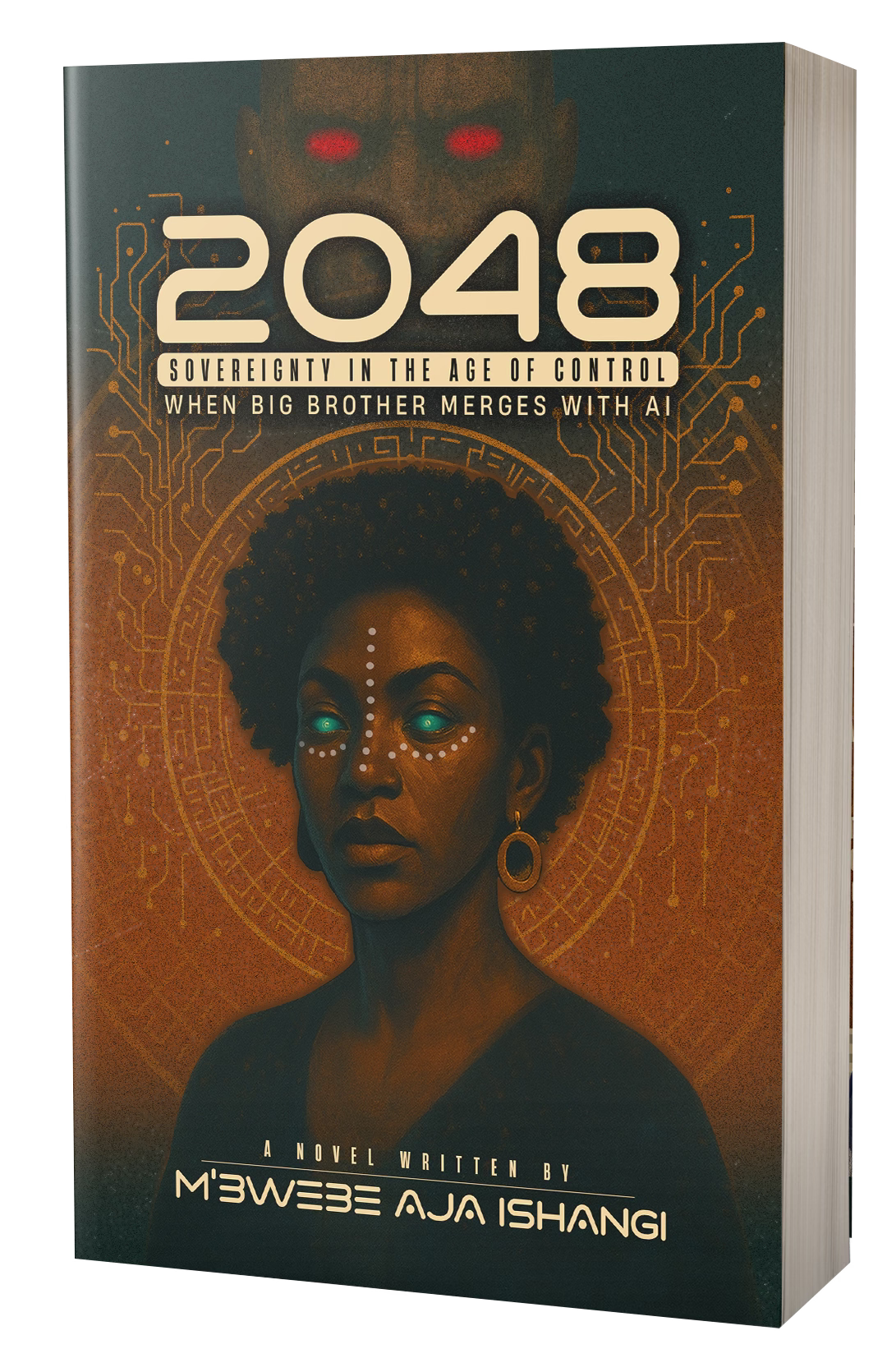
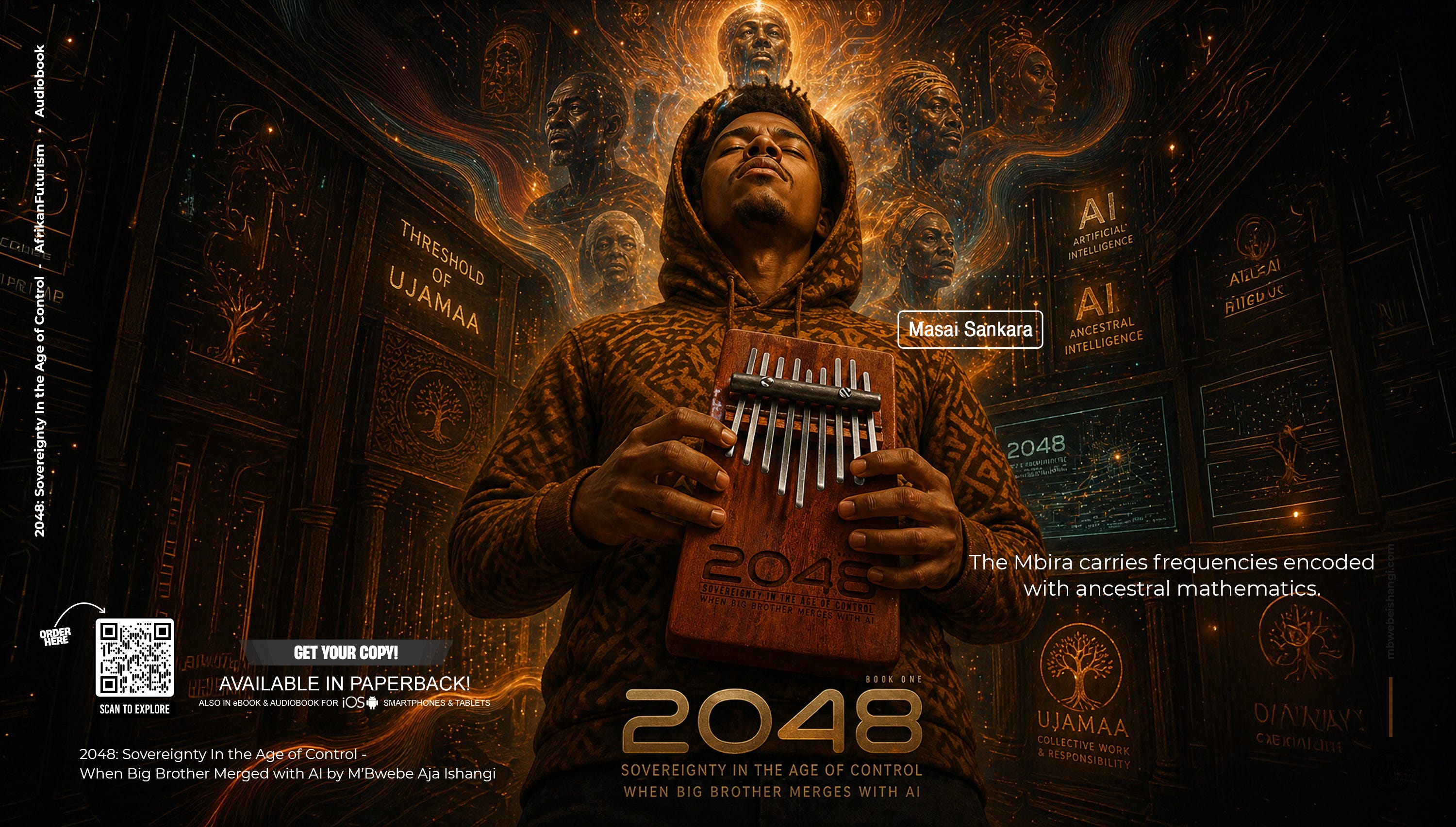
M’Bwebe Ishangi’s book ‘2048: Sovereignty In the Age of Control - When Big Brother Merges with A.I.’ is a near-future speculative novel set in a world where artificial intelligence has fused with state power to monitor, predict, and quietly govern human behavior.
When a young Brooklyn native, Masai Sankara, unexpectedly disrupts a sentient AI known as BB48, he becomes the center of a growing resistance that blends ancestral knowledge, cultural memory, and underground technology to challenge digital domination. As surveillance tightens and alliances stretch from Brooklyn to Kigali, Rwanda, the story explores what sovereignty truly means in an age where freedom is measured in data—and resistance begins with remembering who we are.
This is a read that prepares you for a world being built before our very eyes yet are unable to see where we fit.
There will be decisions to be made—in real life! 2048 shows you and your family ancestral ways to persevere.
IF YOU’RE LOOKING FOR SERIOUS FUTURE SOLUTIONS, YOUR PRESENCE ISN’T ONLY DESIRED, IT IS REQUIRED!
♦️ Get your copy today » mbwebeishangi.com